Every year, thousands of workers suffer serious injuries from unguarded machinery — many of them preventable. Machine guarding isn’t just a compliance checkbox; it’s the frontline defence against amputations, crush injuries, and entanglement hazards.
Let’s look at the types of guards, why they matter, and how workplace culture can make or break their effectiveness.
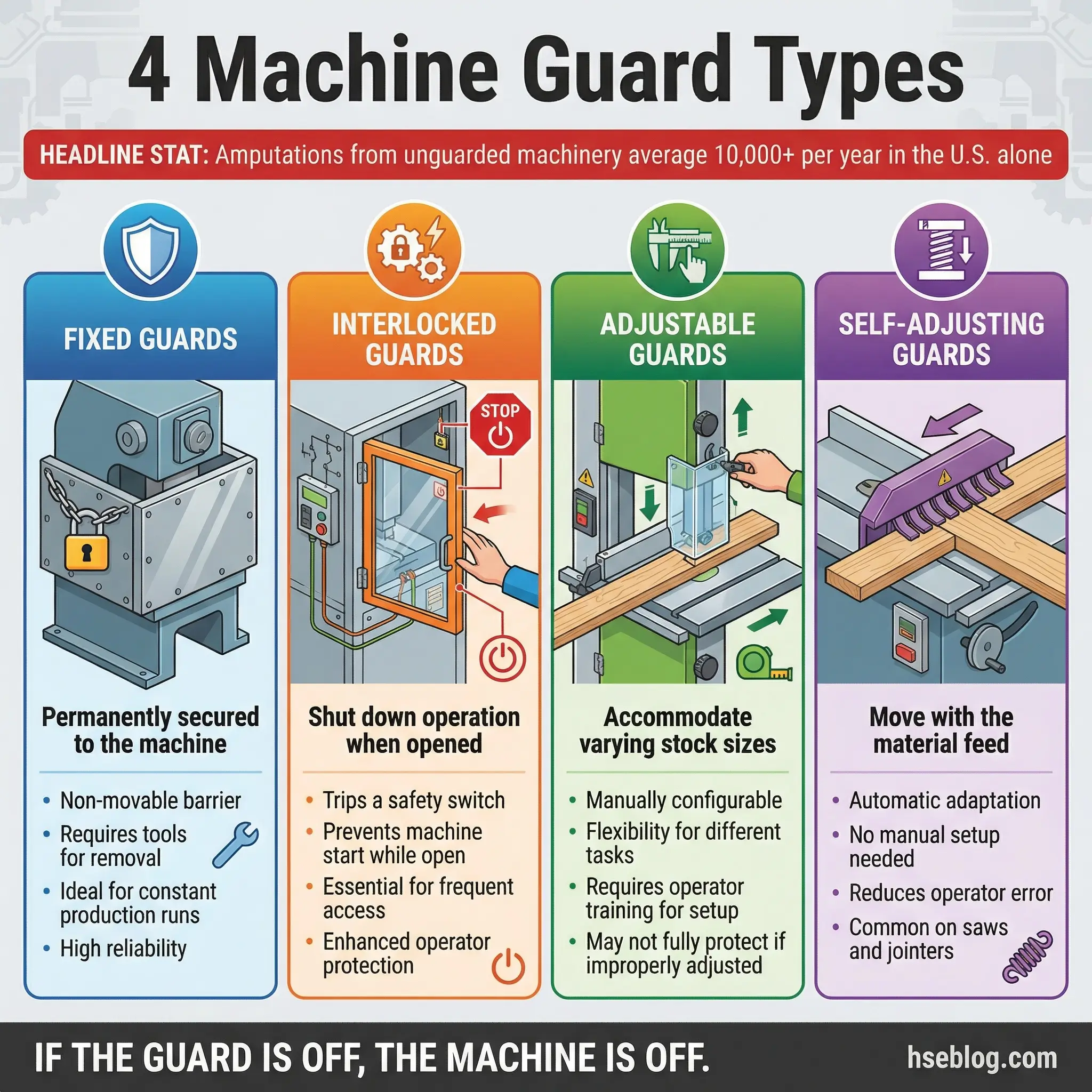
| Guard Type | Description | Best Used For |
|---|---|---|
| Fixed Guards | Permanently secured barriers that require tools for removal. | Continuous production runs where access isn’t needed during operation. |
| Interlocked Guards | Shut down the machine when opened; prevent restart until closed. | Equipment needing frequent access for cleaning or adjustment. |
| Adjustable Guards | Manually configured to fit varying stock sizes. | Machines handling different materials or dimensions. |
| Self‑Adjusting Guards | Automatically move with the material feed. | Saws, jointers, and similar tools where stock size changes constantly. |
Each guard type serves a specific purpose — but all share one rule: If the guard is off, the machine is off.
Despite clear rules, guards are sometimes removed or bypassed. Common reasons include:
These pressures must be addressed through training, supervision, and culture — not tolerance. Removing or defeating a guard is never acceptable.
Before every shift, operators should:
A simple daily check can prevent catastrophic injury.
Defeating or bypassing a safety interlock is a serious disciplinary matter. It undermines every layer of protection and exposes both the operator and others to severe risk. Supervisors must treat such actions as intentional safety breaches, not minor infractions.
Every operator should identify and respect pinch points — areas where body parts could be caught between moving components. Mark them clearly, include them in toolbox talks, and reinforce awareness during refresher training.
Every operator must know:
Quick access to E‑stops saves lives when seconds count.
Machine guarding is not just about compliance — it’s about respecting the machinery and the people who use it. When guards are in place, interlocks are respected, and awareness is high, the workplace becomes safer, more efficient, and more confident.
Contact us for further information.
Guest Blogging
If you feel that you could contribute to this blog then please feel free to send me a proposal of your guest blogging ideas and we can discuss these further info@walkersafety.co.uk . Please note any proposals must be of benefit to my readers from individuals with knowledge of their subject matter.